
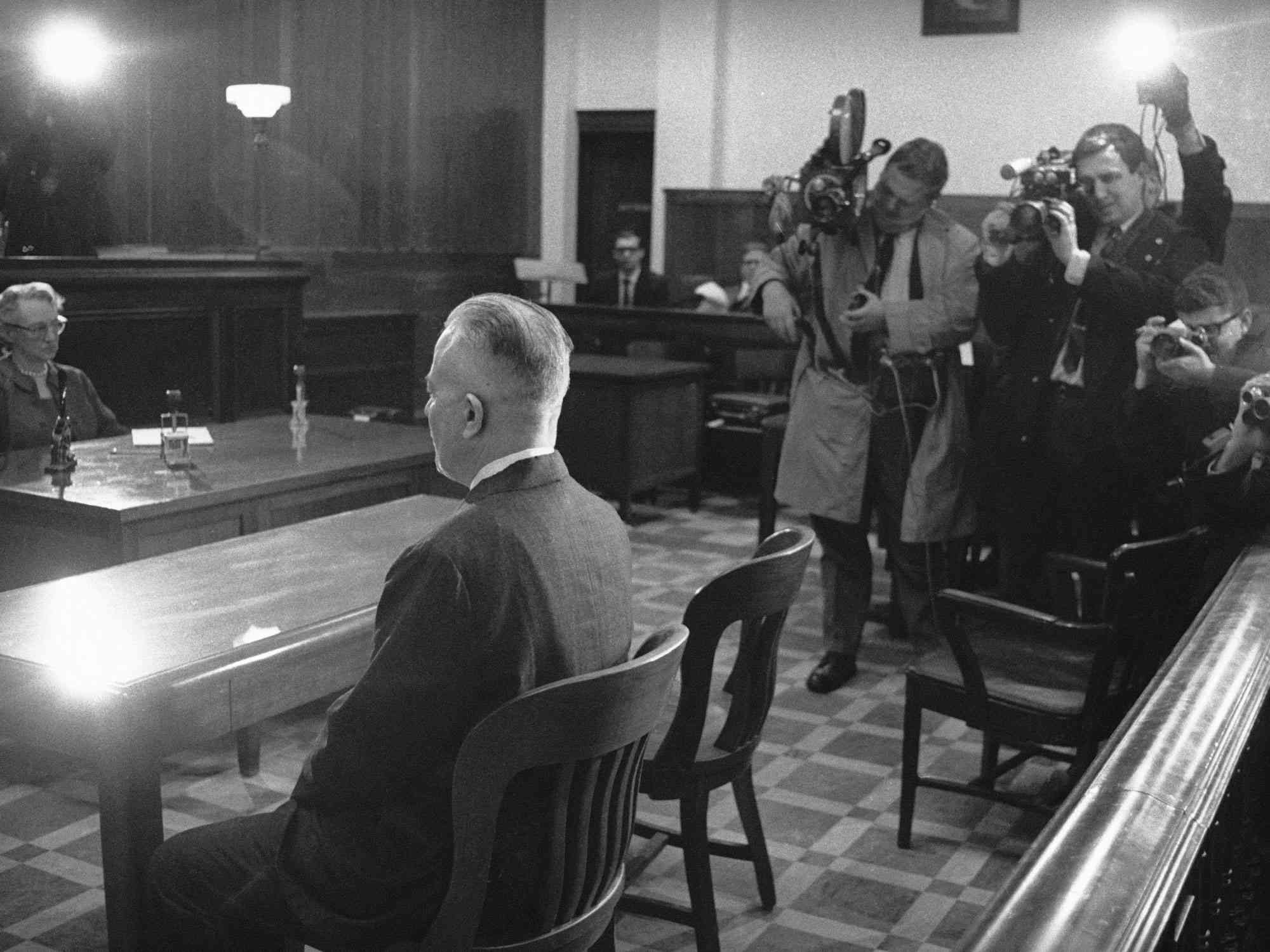
State of Wisconsin v. Edward Gein November 14, 1968
The Following is the transcript from Judge Robert H Gollmar’s ruling on whether Ed Gein was guilt of first degree murder at the end of the trial in 1968.
” At the close of the testimony yesterday the court indicated that it wanted time to reflect and make a decision as to the type of offense proven under the facts in this case.
Before the court goes into its consideration of the evidence, the court has a couple of general statements that it wants to make.
We live in a country in which we have what we believe to be a democratic form of government. The court presumes that was brought most forcefully to the attention of everyone last week when we had an election in this country, and the court won’t take any sides in that election by commenting on it. The court merely wants to point out that the electors were divided almost evenly between the two popular candidates. Nevertheless, the next day when the election was over, there were no armed rebellions in this country. The people who lost accepted their loss, and the court has no doubt, made up their minds that they would proceed under our democratic process to regroup their forces, as it were, and move toward the next election.
One of the important features of our form of democracy, in the court’s judgement, is our concept of law, our courts—and the care we take to make sure that every person accused of a crime has a full, fair, and complete trial. Not only is he given his day in court, as it were, but we also make every effort to make sure that he has, or she has, the assistance of, represented by competent counsel, skilled in this particular area of the law.
The court makes these statements particularly because the court is well aware of the fact that there are people—and undoubtedly people in this community—who have expressed some doubts as to whether or not this case should be tried. The court is sure there are some people who have prejudged it and usually sure there are some who have criticized those who determined that Mr. Gein was to stand trial and returned him here for trial.
This court is firmly committed to the concept that one of the great things we have in America is the right of every man to have a trial, either before a jury or in open hearings. This is the day in court that we must go to, because when the day comes that it is denied to us, then we, in the court’s opinion, are no better off than the rest of the world, and the rest of us who think we are good citizens, will find ourselves deprived of our rights.
The court wants to commend counsel on both sides. This case has been well tried, and carefully prepared, even though it was not at all easy to prepare and try because it is now eleven years after the fact. Counsel has done an excellent job. They have conducted themselves properly, in a lawyer-like manner at all times. The court is pleased with them.
The court too is pleased with the community because, again, as in the election, there are, as the court said, many people the court is sure, who take a rather dim view of this trial. Nevertheless, no one in this community has made any effort to interfere with the process of justice, to take the law into his own hands, or do anything of an improper nature.
Now, the issue before the court this morning is a specific finding as to the offense.
The defense in this case is basically one of accidental discharge of the gun, and the thrust of this argument of course is that that would remove any intent.
Experts who have examined this gun have testified that the gun was in perfect mechanical condition and that the gun contained certain safety factors. One, of course, is the mechanism just behind the trigger, and another is a built-in safety factor that requires release by pressing a lever on the bottom of the gun.
Evidence discloses without any question that the defendant was familiar with firearms; he had been using them from the time he was eight years old. He indicated that squirrels had been a great annoyance to him, and that he had shot squirrels. In fact, he had shot one the day before. The court thinks it reasonably probable that the defendant is an excellent marksman and that his skill has probably been sharpened by his squirrel hunting.
The court thinks, too, that we have to take into consideration the facts immediately after the shooting. The defendant testified that after Mrs. Worden disappeared from his line of vision, that he went around the side and he saw her lying on the floor. He did not check to see if she was dead or alive. From that point on, the course of conduct is not that which one would think most people would do if a shooting were accidental. The court thinks most people under the circumstances of an accidental shooting would rush out into the street and seek immediate aid, try to get a doctor, or so forth. The defendant did not do this.
The court does not accept the defendant’s story. It just does not ring true to the court. The court is satisfied that when Mrs. Worden walked across the room just at some point prior to the actual shooting the court is satisfied that the defendant formed an intent. Why, the court doesn’t know, and the court doesn’t want to know. But the court is satisfied that he formed an intent to take Bernice Worden’s life.
The surrounding physical facts indicate to the court that the odds are very great that if the shot had been fired in the manner the defendant indicated, it would not have been possible for the bullet to go through the materials that were in the way and enter directly into the head of Mrs. Worden.
The court is afraid that the defendant was “squirrel hunting” that day, and the court is satisfied that he was deliberately prepared to place that bullet in Mrs. Worden’s head.
In summation of all of this, the court has determined that the offense committed here is first degree murder and we so find.
The court does find that on November 16, 1957, the defendant, Edward Gein, was suffering from a mental disease. The court does further find that as a result of this mental disease he lacked substantial capacity to conform his conduct to the requirements of law. The court does, therefore, find the defendant not guilty by reason of insanity. The defendant is, therefore, committed to Central State Hospital for the Insane. “
Leave a Reply